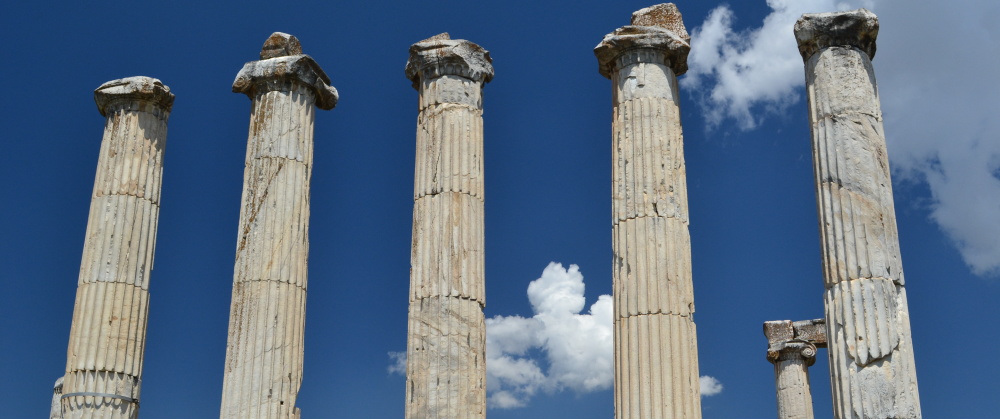
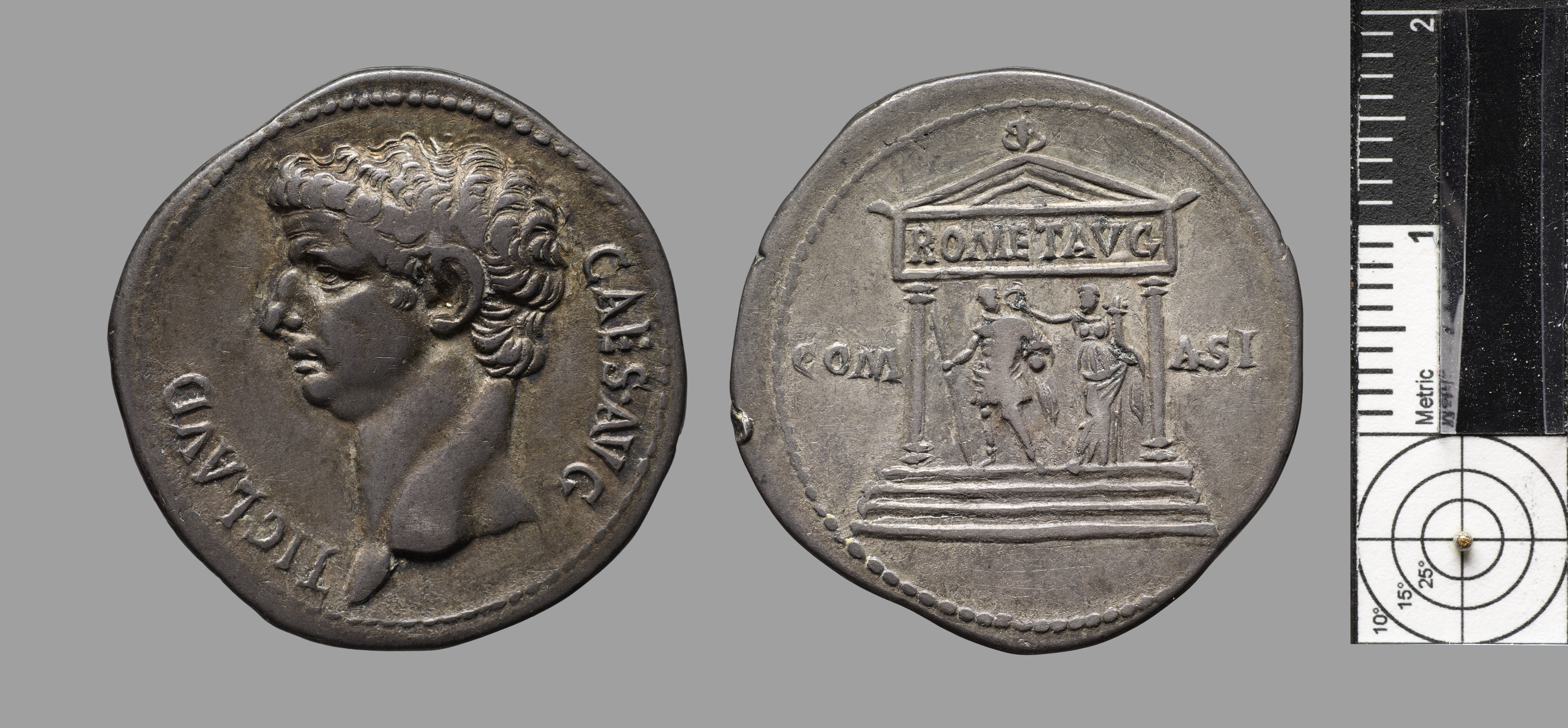
For example, in Rome and her colonies, imperial divine honors tended to be given to deceased Julio-Claudians whom the Roman Senate deified and provided a temple, cultic statue, altar, priests, sacrifices, festivals, and the official title Divus (for a male Julio-Claudian) and Diva (for a female Julio-Claudian). Because this deification tended to be reserved for Julio-Claudians who advanced the interests of Rome and her empire, not every emperor or Julio-Claudian was hailed as a Divus. For a list of these divi (the Latin plural of divus), see p. 43 of my book.
In Greek provinces, a group of provincials most often worked with the Roman provincial administration, the Roman Senate, and the reigning emperor to determine which Julio-Claudian would be given divine honors, where they would be located, and of what the honors in question would consist. These provincial honors were usually bestowed on living Julio-Claudians, but official documents associated with them tended to avoid calling the honored a “god” (theos in Greek). Moreover, the reason for their establishment was typically to be show gratitude for imperial benefaction and to court such future munificence.
Greek cities most often provided imperial divine honors to living Julio-Claudians to render appropriate gratitude for a specific beneficence and to court more acts of charity. Once the Julio-Claudian divinely honored died and thus could no longer benefit Greek cities concretely, they tended to lump that imperial into a growing number of divine imperials known as Augustan gods, θεοὶ Σεβαστοί (with the emperor Augustus being the chief exception). The traditions by which cities honored divinely the Julio-Claudians were local and some of them stretched back to Hellenistic period of Greek history and even beyond. Therefore, such honors were diverse. Given that there was no Roman oversight of these grants of divine honors, denizens of cities were free to call living or deceased Julio-Claudians “gods” or manifestations of the Olympians.
Finally, ancient Greeks and Romans divinely honored Julio-Claudians, both dead and alive, in their own homes, to varying degrees, and for varying reasons. For example, archaeologists working in Ephesus found a domestic imperial shrine in an elite apartment (insula) in a house in a block of such apartments (insulae) known as Terrace House 2. The shrine dates between AD 14 and 37 and consists of busts of Tiberius and Livia that had been set in a domestic shrine in a niche in the wall.
For the shrine, see Elisabeth Rathmayr, “New Evidence for Imperial Cult in Dwelling Unit 7 in Terrace House 2 in Ephesos,” in Ephesos as a Religious Center under the Principate, ed. Allen Black, Christine M. Thomas, and Trevor W. Thompson, WUNT 488 (Tübingen: Mohr Siebeck, 2022), 9–35. Often, scholarly works reference a bronze snake that was found with Tiberius’s and Livia’s busts. However, Rathmayr demonstrates that this is not the case and that the snake was placed in front of the niche much later.
In short, to quote Nijay Gupta’s excellent blurb about my book, “imperial divine honors were everywhere . . . [but] they were not everywhere the same.” This means that the early Christian interactions with them were not uniform and must have varied from city-to-city and province-to-province. For more on these interactions, check out my new book!
I am thrilled that my new book, Paul & Imperial Divine Honors, is out in print! In this work, I introduce imperial divine honors, more commonly called imperial cult in New Testament circles, to a more general audience and then provide contextual reconstructions of imperial divine honors in first century AD Corinth, Philippi, and Thessalonica with the goal of adjudicating with precision what relationship, if any, these honors had to early Christianity in these cities.
This book is one on which I have been working since Spring 2010 when I took my first class on imperial divine honors at Harding School of Theology (Memphis, TN) and it is much more than words on a page. I have procured (and in some cases paid for) the rights to publish 43 images and maps from and associated with ancient Corinth, Philippi, and Thessalonica and, in an appendix, I provide 60 Latin and Greek inscriptions associated with Corinthian, Philippian, and Thessalonian imperial divine honors along with fresh translations of them.
I hope this work will be of use not only to scholars but also to clergy as they reconstruct the gospel in its original imperial context and exegete what it means for the Church in our modern context.
Most scholars agree that Paul composed his letter to the Romans to a group of house churches that consisted mostly of Gentile Christ–confessors and a minority of Jewish ones (although some dispute this reconstruction). It is probable that many of the former group were God–fearers—Gentiles who frequented Jewish synagogues and were attracted to certain tenets of Judaism—and proselytes to Judaism before they confessed Jesus as Messiah. The method most scholars use to arrive at this reconstruction is a combination of a critical reading of Romans,[1] Greco–Roman literature,[2] and inscriptions.[3]
It is the use of this last dataset with which I take issue and suggest that scholarly use of inscriptions must be more critical. Many scholars point to Jewish inscriptions from Rome that mention between eleven and thirteen synagogues (the number is debated):
The synagogue of the Agrippesians (JIWE 2.170, 562, 130 [?], 549);
The synagogue of the Augustesians (JIWE 2.547, 169 [?], 194, 189, 542, 96, 547);
The synagogue of the Calcaresians (JIWE 2.69, 558, 98, 584, 165);
The synagogue of the Campesians (JIWE 2.560, 288, 577, 1);
The synagogue of Elaea (JIWE 2.576, 406);
The synagogue of the Hebrews (JIWE 2.33, 578, 2, 579);
The synagogue of the Secenians (JIWE 2.436);
The synagogue of the Siburesians (JIWE 2.338, 452, 527, 557, 428, 451 [?]);
The synagogue of the Tripolitians (JIWE 2.166);
The synagogue of the Vernaclesians (JIWE 2.106, 117, 540 [?], 114);
The synagogue of the Volumnesians (JIWE 2.100, 167, 163, 577);
The synagogue of Acra (synagogue is reconstructed in this inscription and this reading is now rejected, JIWE 2.568); and
The synagogue of the Rhodians/Herodians (JIWE 2.292).[4]
All of the inscriptions that mention the above synagogues are epitaphs or funerary inscriptions from Jewish catacombs in Rome. Therefore, they are not from the actual synagogal structures themselves. None of these epigraphs date to the first century CE; the time when Paul composed Romans (probably between 56 and 58 CE). Rather, these inscriptions are dated paleographically (that is, by the form of their letters) between the third and fourth century CE with one even dating to the fifth century CE.
Despite their late dating, some prominent scholars such as Joseph A. Fitzmyer and Richard Longenecker conclude that the above synagogues existed in the mid–first century CE and they use the offices mentioned therein to reconstruct the organization of Roman synagogues at that time.[5] For example, Fitzmyer contends:
“[F]rom thousands of funerary inscriptions . . . we learn about the Jewish population there and its groupings into thirteen synagogues . . . From such sources we also learn that the Jewish community in Rome was organized; a synagōgē was governed by a gerousia, ‘council of elders,’ presided over by a gerousiarchēs. These were the archontes of the community; there was also a phrontistēs, ‘administrator’ of the community’s material goods and supervisor of the dole [of grain]. Among them were also hiereis, ‘priests,’ but that was probably a title of honor for members of priestly families, since there was no temple.”[6]
Peter Richardson exercises more caution. He argues that only five of these known synagogues likely existed in the mid–first century CE: those named after patrons—Augustus (Augustesians), Agrippa (Agrippesians), Volumnius (Volumnesians) (maybe?), and Herod (Herodians)—and the synagogue of the Hebrews. Richardson suggests that Augustus (63 BCE–14 CE; reigned 31 BCE–14 CE), patronized the synagogue of the Augustesians, Augustus’s son–in–law, Marcus Agrippa (63–12 BCE), the synagogue of the Agrippesians, Volumnius, the procurator of Syria from 9 to 7 BCE, maybe the synagogue of the Volumnesians, and Herod the Great (73–4 BCE; reigned 37–4 BCE) patronized the synagogue of the Herodians. Finally, he posits that the synagogue of the Hebrews is the earliest in Rome and was formed when Jews in Rome still spoke Aramaic/Hebrew.[7]
The epigraphic evidence does not support the conclusions of Fitzmyer and Longenecker. There is no reason to presume that because a synagogue existed in the third and fourth century CE that it existed in the first century as well. What is more, it is anachronistic to assume that the third and fourth century CE organizational structure of the Roman synagogues applies to the mid–first century CE (for which there is little evidence).[8]
Richardson’s reconstruction is more careful, but still problematic. The main reason is that in the end it is conjecture, albeit with varying degrees of likelihood and probability. It is likely and even probable that Augustus and Agrippa patronized the synagogues of the Augustesians and Agrippesians respectively and that these two existed in the first century CE.[9] However, his conclusion that Volumnius the procurator of Syria may have patronized the synagogue of the Volumnesians does not convince for two reasons. First, the only connection that this Volumnius had with Second Temple Jews is that he served as procurator of Syria (something that Richardson acknowledges), which is not enough evidence to conclude that he patronized a synagogue in Rome.[10] Second, there were numerous Volumnii in the capital of the empire (another observation that Richardson acknowledges).[11] Therefore, one of them may have patronized the synagogue in question.
Richardson’s proposal that Herod the Great patronized a synagogue is also unconvincing. The name Herodians is reconstructed in an epigraphic lacuna because of the fragmentary nature of the surviving inscription:
However, some epigraphers reconstruct Rhodians (ΙΡΟΔΙΩΝ), not Herodians (ΗΡΟΔΙΩΝ).[13]
Leon proposes that there is no evidence that this fragmentary inscription refers to a synagogue at all because:
“in all other inscriptions [from Rome] on which the name of the synagogue appears this name immediately follows the word συναγωγῆς or is separated from it only by the article τῶν, whereas here there is a large gap before the alleged name of the synagogue.”[14]
In the end, any reconstruction of what may have been in the inscription in question is what epigraphers call “history from square brackets,” which is unreliable.
Finally, the reasoning of Richardson that the synagogue of the Hebrews is the earliest one in Rome—and thus that it dates to the first century CE—is not without difficulty. His main supporting evidence is the supposed first century CE date of the synagogue of the Hebrews in Corinth. However, that inscription does not date to the first century CE, but, as the official publication of the epigraph states, it dates “considerably later than the time of St. Paul.”[15] Hence, it is unclear if the synagogue of the Hebrews in Corinth and thus Rome can be dated to the first century CE.
In short, despite claims to the contrary, there is not concrete inscriptional evidence of numerous first century CE Roman synagogues. There is only likely epigraphic data for two first–century CE synagogues: those of Augustesians and Agrippesians. With this conclusion, I am not claiming that more synagogues did not exist. The first century BCE–CE Jewish philosopher Philo of Alexandria clearly notes that more than one synagogue existed in Rome during Augustus’s reign when he testifies that Augustus knew of Jewish synagogues (plural), which Philo calls proseuchai (προσευχὰς; Acts 16:13, 16), and that Jews studied Torah in them on Sabbaths (Embassy 156).
What I am claiming is that there is no certain epigraphic evidence for eleven to thirteen first–century CE synagogues in the city (as Fitzmyer and Longenecker claim) or likely five first–century CE synagogues (as Richardson suggests). This negative conclusion notwithstanding, these later Jewish inscriptions that mention synagogues do provide some important evidence for Jewish life in first century CE Rome. They were found in Jewish catacombs near the right bank of the Tiber River in a region of the ancient city known as Transtiberine (modern–day Trastevere).
The find–spots of these inscriptions support Philo’s testimony that a large Jewish population lived there in first–century BCE–CE (Embassy 155).[16] However, the number of synagogues that these Jews established remains unknown.
Want to know more about how inscriptions can help to interpret the New Testament documents? Then purchase my latest book, Studying the New Testament Through Inscriptions: An Introduction:
[1] Paul clearly addresses Gentile Christ–confessors in Romans (1:5, 13; 11:13; 15:15–16) as well as Jewish ones (1:16; 2:9–11, 17–29; 3:29; 10:12; 16:7, 11).
[2] These sources have been gathered by Menahem Stern, Greek and Latin Authors on Jews and Judaism, 2 vols. (Jerusalem: Israel Academy of Sciences and Humanities, 1974, 1980).
[3] The following inscriptions are taken from David Noy, ed., Jewish Inscriptions of Western Europe Volume 2: The City of Rome (Cambridge: Cambridge University Press, 1995), abbreviated JIWE 2 hereafter.
[4] For the most balanced treatment of these inscriptions see Harry Joshua Leon, The Jews of Ancient Rome (Philadelphia: Jewish Publication Society of America, 1960),135–66.
[5] Joseph A. Fitzmyer, Romans: A New Translation with Introduction and Commentary, AB 33 (New York: Doubleday, 1993), 28; Richard N. Longenecker, Introducing Romans: Critical Issues in Paul’s Most Famous Letter (Grand Rapids: Eerdmans, 2011), 64–65; Robert Jewett (Romans: A Commentary, Hermeneia [Minneapolis: Fortress Press, 2007], 57–58) proposes that only eleven synagogues existed in Rome, which seems to imply that he believes that they existed in first century CE Rome. James D. G. Dunn (Romans 1–8, WBC 38a [Waco, TX: Word Books, 1988], xlvi) is somewhat more cautious when, identifying ten to thirteen synagogues, says that they “may” date to the first century CE.
[6] Fitzmyer, Romans, 28. Longenecker’s (Introducing Romans, 66) reconstruction is similar: each synagogue had a council of elders, a chief elder, rulers (who were elected every one to three years), a head of a synagogue in charge of worship, an administrator who supervised the congregation’s goods, and a secretary (there were priests but that was an honorary title)
[7] Peter Richardson, “Augustan-Era Synagogues in Rome,” in Judaism and Christianity in First-Century Rome, eds. Karl P. Donfried and Peter Richardson (Grand Rapids: Eerdmans, 1998), 17-29. See also Wolfgang Wiefel, “The Jewish Community in Ancient Rome and the Origins of Roman Christianity,” The Romans Debate, rev., ed. Karl P. Donfried (Peabody, MA: Hendrickson, 1991), 85–101.
[8] For what little is known of Second Temple Jewish synagogue liturgy see Lee Levine, The Ancient Synagogue: The First Thousand Years, 2nd ed. (New Haven: Yale University Press, 2005), 530–61.
[10] Richardson (“Augustan-Era Synagogues,” 22) concludes, “An argument in favor of the association is that no other of the several known Volumnii had even this degree of contact with Jews, so far as can be ascertained.”
[12] Richardson (“Augustan-Era Synagogues,” 27) translates as follows: “X X X name X X X [ruler of the syna]gogue [of the He]rodians [age??] A blessing to all.”
[15] Benjamin D. Meritt, ed, Corinth VIII,1. The Greek Inscriptions 1896-1927 (Cambridge, MA: Harvard University Press, 1931), 78–79, no 111. Richardson (“Augustan-Era Synagogues,” 20) dates this inscription to the second century CE and contends that the synagogue mentioned in it existed in the late first century CE.
[16] Leon (Jews, 136) concludes, “It may be regarded as reasonably certain that the earliest substantial Jewish settlement was in the Transtiberium . . . on the right bank of the Tiber and that the bulk of the Jewish population was concentrated in that area throughout the ancient period and even into the Middle Ages.”