
In this book, Najeeb T. Haddad explores and critiques the scholarly trend of reading St. Paul and his letters in light of “empire criticism,” which he defines as “how” St. Paul “engages with the presence of Rome,” “how” he “offer[s] arguments for and against empire, and how Greco-Roman religion, especially imperial cult, could have influenced” him (2).
In the first chapter, “Paul, Politics, and Empire” (1–27), Haddad places “empire criticism” into its modern social context, the numerous military engagements and forever wars in which the United States of America remains embroiled. He, then, contextualizes Rome’s first century AD power structures and how she integrated and/or suppressed foreign peoples and their cults. Haddad concludes that Rome’s main goal with regard to her power and her attitude toward foreign peoples and their cults was to maintain her hegemony. He demonstrates that if any cult threatened that power, Rome suppressed it. One of these cults was Judaism, which gave birth to Christianity. Therefore, Haddad is adamant that one must understand St. Paul as a Second Temple Hellenistic Jew and the history of Roman-Jewish relations to understand the place of empire in the study of the apostle.
The second chapter, “Methods of Empire Criticism in Paul” (28–51), explores and critiques three non-exclusive “sections” of empire criticism: “polemical parallelism” advocated by Adolf Deissmann and N. T. Wright, “imperial cult” advanced by Karl P. Donfried, Richard Horsley, and Bruce Winter, and “hidden criticism” endorsed by Wright and Horsley. Concerning the first, Haddad proposes that parallelism does not necessarily equal a polemic. With regard to the second, he contends that these scholars work with an improper understanding of “imperial cult” and he agrees with Colin Miller that the “imperial cult” did not have a central place in most cities in which St. Paul established nascent Christian congregations. Finally, Haddad picks apart the underlying assumptions of “hidden criticism,” which he says stems from a failure of the first two “sections” to produce a convincing “empire critical” reading of St. Paul.
In the third chapter, “Goals and Techniques for Empire Criticism in Paul” (52–78), Haddad attempts to nuance the discussion of empire criticism in St. Paul by providing methodological clarity. He pushes readers to consider data outside written texts and then explores two facets of antiquity, the polis or city-state in Greek and the place of ancient associations in the civic landscape. Haddad examines what a polis meant for first century denizens of the Greco-Roman world: an entity in which families strive together to meet their civic and cultic duties. In this context, Haddad places St. Paul whom he says knew that civic authority was necessary for civil and economic stability of the empire, despite the occasional tyrant. As far as ancient associations are concerned, he notes that they provided stability to society and encouraged the worship of an associational patron deity. St. Paul’s congregations resembled ancient associations save for the offering of members participation in the resurrection and a new heaven and new earth.
The fourth chapter, “The Theological Significance of Pauline Empire Criticism” (79–107), tries to produce a more nuanced empire critical reading of one Pauline letter, Philippians. In the process, Haddad reads the missive in light of the apostle’s understanding of the new creation that has dawned in the Messiah event. On the one hand, St. Paul’s converts were adopted children of God, they were filled with God’s Holy Spirit, and they were “in Christ.” On the other hand, this new existence does not result in antagonism, but in believers’ “willful and voluntary obedience” to God just like Jesus, as the so-called Philippian hymn (Phil 2:5–11) underscores.
In the final chapter, “Conclusion: Paul and Empire Criticism” (108–10), Haddad summarizes his work and highlights what he considers two main points: St. Paul was a Hellenistic Jew, which means that from his Jewish upbringing the apostle already had a vision of the relationship between political authority and Judaism; and the lack of empire criticism being founded upon the traditional historical-critical method.
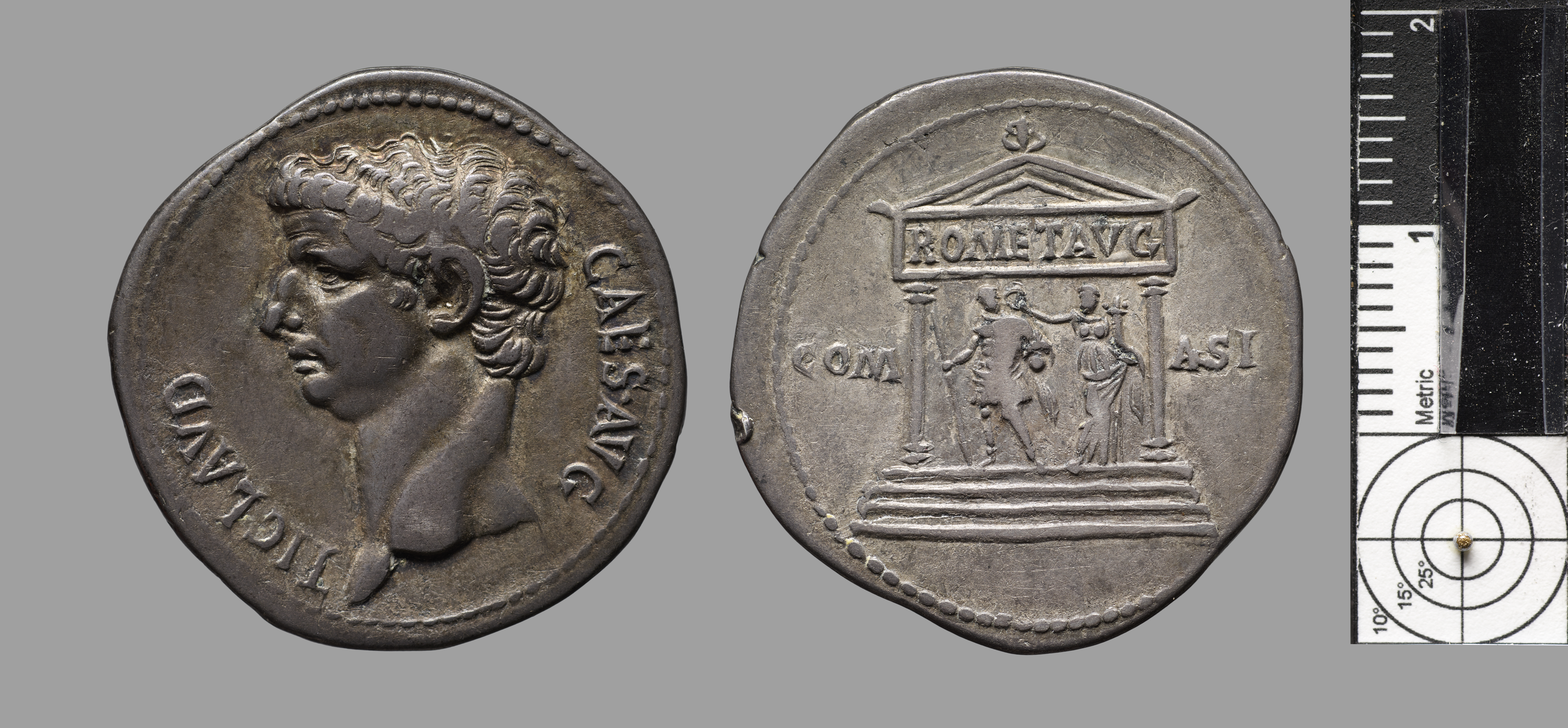
Haddad’s work is careful and nuanced and I appreciate his main emphasis on reading St. Paul’s letters in light of the new creation that has dawned in the Messiah event, his desire to move the empire critical discussion to more methodological clarity by exposing some of flaws in its current “sections,” and his use of material culture to interpret Philippians. However, there is one area in which this volume that is deficient and which I must push back: Haddad’s understanding of the role of the so-called “imperial cult” is inadequate, which stems from his reliance upon Colin Miller’s earlier, flawed work. Miller’s contention that “the imperial cult” was not particularly important for the cities in which St. Paul established congregations was built upon his misguided understanding of imperial divine honors, a term that I prefer, as a monolith religious movement instead of a complex, contextual series of divine honors that individuals, associations, cities, provinces, and Rome established to show appreciation for imperial benefaction. Moreover, as I show in my recent book, numismatic, archaeological, and inscriptional evidence demonstrates conclusively that imperial divine honors were a major part of the civic landscapes of Philippi, Thessalonica, and Corinth.
In short, if readers understand this one area of deficiency of Haddad’s work, then his Paul & Empire Criticism: Why and How? is a great introduction to empire criticism and some of the methodological problems!
I am grateful to Cascade Book for providing me with a copy of this work, which in no way prejudiced my review of it.