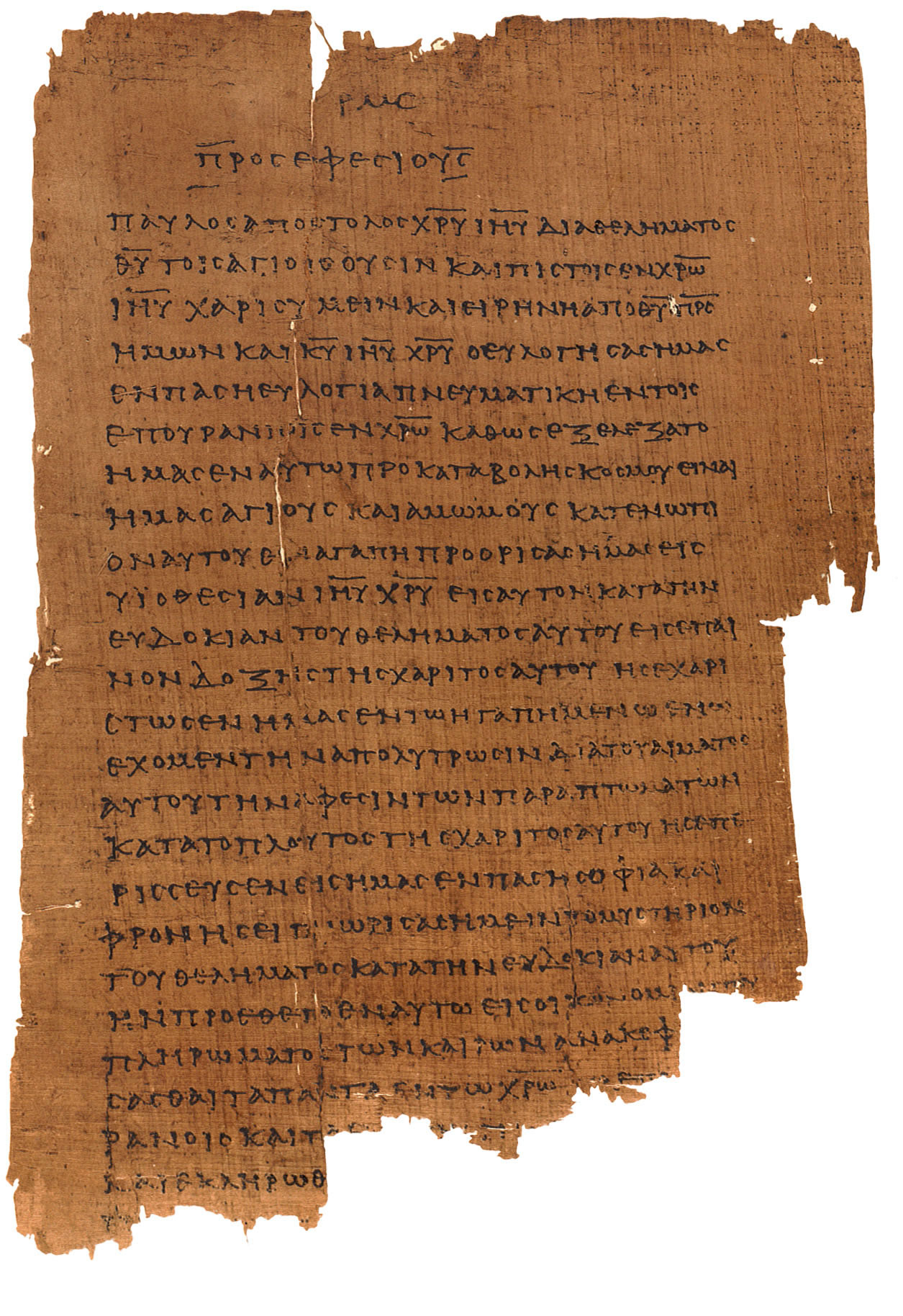
The Greek New Testament, 6th rev. ed., eds. Hugh Houghton, Christos Karakolis, David Parker, Stephen Pisano, Holger Strutwolf, David Trobisch, and Klaus Wachtel (Stuttgart: Deutsche Bibelgesellschaft, 2025)

This sixth revised edition of the Greek New Testament (NT) (UBS6) is for the United Bible Societies and thus for the use of translators and students of the Greek NT. Its text is identical to the forthcoming Nestle-Aland 29th edition and the main difference between the two editions is that the UBS6 has only variation units the editors have deemed “necessary” for the understanding, revising, and translating of the NT. The committee has revised the new volume from feedback of translators who used UBS5, from new textual discoveries, and from revisions to the editorial text of the NT in the newest and ongoing critical edition, the Novum Testamentum Graecum Editio Critica Maior (ECM) (for more on this project and how it relates to the UBS6, see my former post here). Since the ECM volumes published to date are on St. Mark’s Gospel (2021), the Acts of the Apostles (2017), the Catholic Epistles (2013), and Revelation (2024), the changes to the Greek editorial text of UBS6 relates to these books.
This new edition witnesses six major alterations. First, the editors have revised the order of the NT books to reflect their sequence in Codex Vaticanius and Codex Alexandrinus (for more information, see my former post here). Thus, the UBS6 books are ordered as follows: the Gospels, Acts of the Apostles, the Catholic Epistles (less Hebrews), the Pauline Corpus (with Hebrews after 2 Thessalonians), and Revelation.


Second, after reviewing every variation unit in UBS5, the committee was convinced of the need to pay “greater attention” to the Byzantine tradition, including the Textus Receptus, which stands behind the translation of the King James Bible (VIII).[1]
Third, the editors have revised the presentation of witnesses in the textual apparatus in five ways. One, they have adopted numerical sigla for Greek manuscripts. Therefore, Codex Sinaiticus is no longer represented by the Hebrew letter א but by the number 01. Two, they no longer cite individual lectionaries. Three, the editors have updated early translations of the NT to reflect the most recent research. For example, the textual apparatus separates the Christian Palestinian Aramaic witnesses from the Syriac tradition and treats them as separate. Four, the editors have reduced the number of citations to early Church Fathers, especially those who did not compose in Greek. And, five, they have reduced the number of manuscripts of Pauline letters based on the textual analysis reflected in the series Text und Tertwert der griechischen Handschriften des Neuen Testaments. The result of these changes is that the textual apparatus is smaller, compact, and not as unwieldy as it was in the UBS5. If the reader wishes to explore more textual witnesses, he or she can access them in the printed volumes of the ECM.


Fourth, the committee has removed references to modern translations of the NT, the Discourse Segmentation apparatus, the Cross-Reference apparatus, the Index of Allusions and Parallels, and the List of Alternative Readings, all of which were features of UBS5.
Fifth, the editors have rewritten the Introduction. And, finally, the committee has reexamined each variation unit redefining the confidence rating of each unit and sometimes changing it (In addition to the UBS6, one of the editors, Hugh Houghton, has prepared a new Textual Commentary on the UBS6. For more information, see my former post here).
The UBS6 is divided into seven parts. In the first part, the “Preface” (VII–X), the committee details the abovementioned changes. The second, the “Introduction” (1*–51*), contains a discussion of the history and background of the Greek NT (1*–9*), the Editorial Text of the UBS6 (9*–12*), its Textual Apparatus (12*–22*), its List of Witnesses (22*–46*), its Biblical Abbreviations (47*), and a Select Bibliography (48*–51*).
The third portion, the “Text and Apparatus” (1–619), is the bulk the UBS6 and consists of the editorial text and variation units. In the fourth part, the “List of Textual Changes Between the Fifth and Sixth Editions” of the UBS (621–26), the committee has provided the list of textual changes from the UBS5 to UBS6. For example, the phrase “Son of God” no longer remains in brackets in Mark 1:1:

| UBS5 | UBS6 |
| Ἀρχὴ τοῦ εὐαγγελίου Ἰησοῦ Χριστοῦ [υἱοῦ θεοῦ] | Ἀρχὴ τοῦ εὐαγγελίου Ἰησοῦ Χριστοῦ υἱοῦ τοῦθεοῦ |
| “The beginning of the Gospel of Jesus the Messiah, [the Son of God]” | “The beginning of the Gospel of Jesus the Messiah, the Son of God” |
This change, however, does not mean that the editors believe υἱοῦ τοῦ θεοῦ to be part of the earliest reconstruct-able text, for they give this variation unit a C rating, which means “The Committee is doubtful about this reconstruction of the text” (13*).
The fifth part of the UBS6, the “Index of Quotations” (627–33), consists of a list of Old Testament (OT) quotations in order of their appearance in the OT (627–30) and NT (630–33). In the sixth portion, “Principal Symbols and Abbreviations” (634–36), the editors have provided a legend for the various symbols and abbreviations found in UBS6 and like previous editions, they also have given the reader an indispensable insert with these data (as well as the Greek manuscripts cited in the Textual Apparatus). The last part of the UBS6, “Maps” (637–38), consists of two maps: one of the eastern Mediterranean world in the time that the NT was being composed and another of Palestine during the same time period.
Finally, it is worth mentioning that the UBS6’s look has been altered from the UBS5 with cleaner, clearer, and crisper fonts on the cover and with the Greek text itself.
This new edition of the UBS6 is a huge improvement from the UBS5 not only in appearance but also in content and layout. It is slender—the revision of the textual apparatus and the omissions of certain unnecessary features of the UBS5 has trimmed over two hundred pages of text—and it is well bound with a durable hard cover.
What is more, I praise the decision to rearrange the NT books to bring it in line with the Church’s Textual Tradition because it reminds readers that most of our interpretations have a long pedigree and that we stand on the shoulders of giant interpreters, the Church Fathers and Doctors.
Granted, some scholars will no doubt find fault with some of the decisions, especially related to the re-rating of the variation units, but, all in all, the UBS6 editorial team has produced an excellent work that will benefit the people for whom they have prepared their editorial text: clergy, beginning students of the Greek NT, and translators of the NT: Bravo, editors! Therefore, buy a copy now, either from Hendrickson Publishers (which is cheaper!!!) or on Amazon.
I am grateful to Hendrickson Publishers for the advanced gratis copy of the UBS6, which is no way influenced by review it.
[1] For a discussion of the Textus Receptus, see https://zondervanacademic.com/blog/textus-receptus.