Douglas J. Moo, The Letters to the Colossians and to Philemon, 2nd ed., Pillar New Testament Commentary (Grand Rapids: Eerdmans, 2024)
This work is a revised edition of Moo’s previous commentary in the Pillar New Testament Commentary series, which was originally published in 2008. Like all commentaries in this series, it is designed for pastors and Bible teachers. To this end, Moo exegetes the text of Colossians and Philemon, interacting with it in the form of the NIV translation and transliterating any Greek terms. He does so with an eye to Biblical theology as a whole and the contemporary relevance of these two letters for the Church today. In the process, Moo references contemporary debates about aspects of these two letters without delving too deep into the details of these scholarly conversations. The updates to his commentary are his interaction with works published since 2008, the rewording of some of his prose to clarify his meaning, and his alteration of some exegetical conclusions.
This volume begins with a preface from the series editor, D. A. Carson, prefaces to the second and first editions of the commentary, a list of texts and translations of primary sources and abbreviations that Moo used,[1] and a bibliography of commentaries and secondary sources on Colossians and Philemon that he referenced.
The first portion of the commentary consists of a comprehensive introduction to Colossians (3–54) in which Moo discusses introductory matters related to the letter. He describes the Colossians, the letter’s original recipients (4–6) and then discusses the letter’s author, whom he concludes is St. Paul (6–20). Moo places the letter’s composition in Rome around AD 60–61, during the apostle’s imprisonment there (20–26), and reconstructs the following occasion: St. Paul composed the letter to “provide the resources that the Colossian Christians need to fend off some kind of false teaching to which they are exposed” (26), which stemmed from a syncretism of local pagan, Jewish, and Christian beliefs and practices (26–41).[2] He then discusses the following theological aspects that are prominent in the missive: Christology (41–44), angelology (44–47), ecclesiology (47–47), the Gospel (49–50), eschatology (50–51), and ethics (51–53). In the introduction’s final portion, Moo lays out the letter’s outline (53–54).
Skipping to his introduction to Philemon, Moo follows a similar structure as with his introduction to Colossians. He discusses the authorship of Philemon, which he (and every sensible scholar) takes to be St. Paul (351–52). Moo considers Philemon to be a Colossian Christian (353), he dates the letter to AD 60–61, and places its composition at the same time as Colossians and Ephesians, during St. Paul’s Roman imprisonment (353–54). Moo grapples with the situation behind the missive to Philemon that caused the apostle to compose the letter and leans toward the hypothesis that Onesimus was a runaway slave who had gone to St. Paul to ask him to mediate for him with his master Philemon, during which time Onesimus became a Christian (354–60). Moo contends that the epistle’s purpose is to demonstrate how Onesimus’s conversion “reconfigured” his relationship with Philemon because of the “fellowship” that they both now share in Christ (363). This new relationship may have resulted in Onesimus’s manumission (364–65). Finally, Moo provides the structure of the missive.
The bulk of the commentary consists of Moo’s comments (55–348, 371–438). For both Colossians and the letter to Philemon, Moo has structured the commentary portion of this volume in the same way. He provides general comments about the section of each letter, which he then breaks down into subsections with detailed comments. He begins each subsection with the text of Colossians or Philemon as translated by the NIV in italicized font. Thereafter, he provides a verse-by-verse exposition of the subsection. Finally, Moo supplies four indices at his work’s conclusion: an index of subjects (439–43), an index of authors (444–54), an index of Scripture (455–74), and an index of extrabiblical literature (475–78).
As expected of Moo’s work, this commentary is clear, concise, careful, well-researched, and, above all, pastoral. My only regret with this commentary is that Moo does not interact with my work on Psalm 110:1 (“The LORD said to my Lord, ‘Sit at my right hand until I make your enemies a footstool for your feet’”) in Colossians.[3] Instead, he relies on the older, but excellent study of David Hay.[4] This small limitation notwithstanding, the second edition of Moo’s commentary on Colossians and Philemon is a great addition to any pastor’s or Bible teacher’s library!
I am grateful to Eerdmans for the gratis copy of this work that in no way influenced my review of it.
[1] Apart from the NIV translation of Colossians and Philemon, quotations from: the New Testament are from the 28th edition of Novem Testamentum; the Old Testament are from the Biblica Hebraica Stuttgartensia (BHS); the Apocrypha are from the NRSV; pseudepigrapha are from The Old Testament Pseudepigrapha, ed. James Charlesworth, 2 vols. (New York: Doubleday, 1983, 1985); and the Dead Sea Scrolls are from The Dead Sea Scrolls Study Edition, eds. F. G. Martínez and E. J. C. Tigchelaar, 2 vols (Leiden: Brill, 1997).
[2] Moo relies on the study by Clinton Arnold, The Colossian Syncretism: The Interface between Christianity and Folk Belief in Colossae, WUNT 2/77 (Tübingen: Mohr Siebeck, 1995).
[3] D. Clint Burnett, Christ’s Enthronement at God’s Right Hand and Its Greco-Roman Cultural Context, BZNW 242 (Berlin: De Gruyter, 2021). This is not because my work was unavailable to him. It came out in 2021 and appears as the sixth entry on a search of “Psalm 110 New Testament” and the twelfth entry of “Psalm 110 Early Christianity” on Wheaton College’s Library’s online catalogue. Wheaton College is where Moo is a Professor Emeritus.
[4] David Hay, Glory at the Right Hand: Psalm 110 in Early Christianity (Nashville: Abingdon Press, 1973).
Stephen J Chester, Paul through the Eyes of the Reformers (Grand Rapids: Eerdmans, 2025)
This work is an adaption of Chester’s earlier volume, Reading Paul with the Reformers: Reconciling Old and New Perspective (Grand Rapids: Eerdmans, 2017), that is “sharper and more succinct” (xiii) and is, at the same time, an expansion in places.
Chester’s main goal is to demonstrate that the New Perspective on Paul’s (abbreviated NPP, hereafter) outright dismissal of and refusal to interact with the Reformers’ interpretations of the apostle and his letters is “misguided” for two main reasons. The first is that most of what NPP scholars assume about the Reformers’ views of St. Paul is incorrect and the second is that NPP interpreters unknowingly rely on the Reformers for some of their fundamental conclusions about the apostle’s theology (xiii).
To accomplish this goal, Chester divides his work into four parts in which there are sixteen chapters.
Part 1 consists of two chapters focusing on “The New Perspective on Paul and the Reformation” and contains material that did not appear in Chester’s 2017 work. In chapter 1 (“The New Perspective on Paul: Context,” 3–8), Chester provides the modern context for the development of the NPP, Pauline exegetes coming to terms with the events of the Holocaust. The second chapter (“Parallel Disciplines: Pauline Theology and Luther Studies,” 9–25) examines the theological developments of Pauline and Luther studies in the mid-twentieth century that led to the NPP and fresh readings of Martin Luther’s theology, which track and resemble each other closely, e.g., interpreting St. Paul and Luther as apocalyptic theologians.
Part 2 is made up of seven chapters examining the shifts in the interpretation of St. Paul’s letters during the Reformation with an eye to how NPP scholars unknowingly interact with them: “Reformation Interpretation and the New Perspective on Paul as Paradigm Shifts.” In chapter 3 (“Perspectives on Paul before the Reformers: Augustine,” 29–37), Chester explores the groundwork for the exegetical grammar of St. Paul’s understanding of grace, human will, and righteousness—especially how the former transforms the believer initially and then throughout his or her lifetime in cooperation with goods works and the Eucharist—that St. Augustine laid.
Chapter 4 (“Perspectives on Paul before the Reformers: The Medieval Era,” 38–48) probes how medieval theologians such as Thomas Aquinas accepted and interpreted St. Augustine’s exegetical grammar of grace, human will, and righteousness because it was against these interpretations of that exegetical grammar that the Reformers reacted. In chapter 5 (“The Reformers’ New Pauline Exegetical Grammar: Context and Emergence,” 49–57), Chester provides the historical and interpretative context for Luther’s call for reform.
Chapter 6 (“The Reformers’ New Pauline Exegetical Grammar: The Human Plight,” 58–75) delves into the Reformers’ view of the plight of humanity apart from Christ, which can be summarized with two words, original sin. However, in adopting Augustinian terminology, the Reformers rejected his understanding of original sin in two ways. The first is that original sin is the loss of “the supernatural gift that before the fall enabled human nature to will what God wills,” which makes original sin “the absence of something good.” For the Reformers, this view could not capture what they stressed about sin and its all-corrupting nature. The second aspect of the Augustine understanding of original sin is his interpretation of “flesh” as “misdirected desires” that disorder “the whole person.” For the Reformers, “flesh” must be the whole human being, not one portion of him or her, because sin captures the whole person, making him or her act against God’s will (59). This leads the Reformers to conclude that God’s purpose in giving the Law was to reveal our sin and need for his grace (Romans 3:20; Galatians 3:19; 66). Most surprising in this chapter (and something that is taken up again in chapter 9) is Chester’s conclusions about St. Paul’s conscience, which contradict Krister Stendahl’s (1921–2008) 1963 article on the subject that many modern Pauline scholars have accepted without reservation. In the article, Stendahl (a Bishop in the Lutheran Church of Sweden) claims that Luther projected his own troubled conscience into his reading of St. Paul.[1] To the contrary, Chester demonstrates that Luther held similar interpretations of Pauline texts that Stendahl used to show that the apostle had a robust conscience before he became a Christian (71–75).
In chapter 7 (“The Context of the Reformers’ Pauline Exegetical Grammar: Salvation in Christ,” 76–93), Chester explores the Reformers’ understanding of salvation in Christ. With their belief in what they considered original sin, the Reformers’ concluded that salvation was the result only of God’s abundant mercy and grace apart from human works or works of the Law (the Reformers interpreted the Law as the whole Law), even after baptism. The Christian is justified “solely through Christ’s person and work” (76). To this end, the Reformers rejected St. Augustine’s understanding of grace as initially infused upon conversion and the later interpretation of medieval theologians of grace as creating habits that cooperated with the believer resulting in an increase of their righteousness through good works (77). Nevertheless, grace changes the Christian in the gift of faith, which is most fundamentally trusting in God’s promises. At that time, the believer receives Christ’s saving benefits. This type of faith/trust is active and justifies the Christian because with it he or she receives Christ’s righteousness apart from any work/merit (77).
Chapter 8 (“Setting the Record Straight: The Reformers’ Contributions to the New Perspective on Paul,” 94–105) demonstrates that NPP scholars depend on the Reformers’ understanding of Pauline anthropology, especially their interpretation of “flesh” as denoting the entire person and its relationship to “sin.” Moreover, NPP interpreters and those who hold to the Apocalyptic Paul intensify the Reformers’ view of salvation in Christ as only a divine initiative, while those who espouse a Covenantal Paul develop the Reformers’ notion of God’s saving activity in the world as having a single divine plan.
In chapter 9 (“Setting the Record Straight: The Reformers and the New Perspective on Paul in Tension,” 106–19), Chester delves deeper into the NPP’s and its precursor Stendahl’s error in claiming that the Reformers understood St. Paul to have an introspective conscience as well as the NPP’s inadequacy in its dealing with the Reformers’ understanding of works of the Law.
Part 3 (“Justification by Faith and Union with Christ in the Reformers’ Exegesis”) is the longest portion of the work and delves into the disagreements and nuances of Christ’s role in justification of three main Reformers, Luther, Melanchthon, and Calvin. It begins with chapter 10 (“Martin Luther: Alien Righteousness and Life in Christ,” 123–41), which probes Luther’s understanding of the essentiality of believers’ union with Christ. Luther held that the Christian is united with Christ because of his or her faith/trust in God’s promises. This act makes faith present and imputes Christ’s righteousness to the believer. It is living life in the Victorious Christ, not anything natural in the Christian, that makes a faithful life and good works possible.
In chapter 11 (“Philip Melanchthon: Justification on Account of Christ,” 142–55), Chester examines Melanchthon’s understanding of justification as a forensic, relational term that results in everlasting life because of Christ’s propitiating sacrifice and role as mediator between God and humanity.
Chapter 12 (“Luther and Melanchthon on Justification: Continuity or Contrast?,” 156–70) compares Luther’s and Melanchthon’s views of justification and concludes that while there are differences in their understanding of it, there are no contradictions: “Luther emphasizes the presence of Christ in faith and employs the motif of joyous exchange between the sinner and the incarnate Christ to help explain what Paul means by justification. This leads him to include the works of believers within justification even as he insists that such works are not in any sense the basis of justification. In contrast, Melanchthon asserts that justification means acceptance on account of Christ’s sacrificial death. The renewal of the believer expressed in works is consequent upon justification rather than part of it” (169).
In chapter 13 (“John Calvin: The Double Grace of Union with Christ,” 171–89), Chester explores Calvin’s view of justification, which he summarizes as five points: (1) faith unites the believer with Christ, at which time “in him” he or she receives justification and sanctification; (2) justification is a forensic, yet participatory concept; (3) sanctification involves putting to death the pre-Christian self and sharing in Christ’s resurrection, which will eventually result in the believer’s resurrection, but in the meantime it manifests itself in good works; (4) Christ’s saving benefits are wisdom, righteousness, sanctification, and redemption; and finally (5) the bond that unites the Christian with Christ is the Holy Spirit (188–89).
Chapter 14 (“John Calvin: Human Response in Union with Christ,” 190–205) continues to explore Calvin’s theology of justification, focusing on his view of the believer’s union with Christ, which is the locus for the expectant good works of a Christian.
Part 4 (“Reading Paul with the Reformers Today”) forms the last portion of the book and attempts to probe the modern exegetical implications of the differences among these Reformers’ views of justification. In chapter 15 (“Paul and the Reformers: Moving beyond the New Perspective on Paul,” 209–19), Chester discusses the NPP and the Paul within Judaism Perspective but focuses mainly on reading John Barclay, Paul and the Gift (Grand Rapids: Eerdmans, 2015),with the Reformers. For example, he notes that Barclay’s notion of the incongruity of God’s grace helps to resolve some of the Reformers’ issues like Calvin’s sharp distinction between justification and sanctification and Luther’s placement of good works as the spontaneous good fruit of good trees: “Barclay does not do either of these things but employes the structure of gift and response to produce a more unified vision. The saving gift is thoroughly incongruous: it goes to the unworthy, unfitting, and unsuitable, and nothing that results from it by way of holiness could provide a basis for the gift . . . Yet the recipients will be changed by the gift” (218).
Chapter 16 (“Paul and the Reformers: Resources for Contemporary Pauline Theology,” 220–34) provides a test case, Romans 4, demonstrating the benefit that the Reformers have for modern Pauline interpreters. Chester shows that Calvin and Luther had reached some of the same insights, centuries earlier, on Romans 4 that NPP scholars have. However, the latter do not acknowledge the former, mainly because of their failure to read them. In short, Chester concludes that “the Reformers offer exegetical insights of continuing relevance for our efforts to interpret Paul’s theology for today” (234).
Finally, Chester provides a bibliography (“Bibliography,” 235–48) and three indices: one for modern authors (“Index of Authors,” 249–50), one for ancient texts including the Bible (“Index of Scripture and Other Ancient Texts,” 251–52), and one for medieval and Reformation texts (“Index of Medieval and Reformation Texts,” 253–54).
Paul through the Eyes of the Reformers is an excellent volume and pairs well with Chester’s earlier work on the subject, Reading Paul with the Reformers. It was this earlier book that changed my perception of the Reformers. Up till that time and throughout my doctorate (which I finished in 2018), I had bought the caricature of them that I found in NPP scholars. Therefore, I concluded that the Reformers were not worth reading because they had nothing to offer modern Pauline studies. However, after reading Reading Paul with the Reformers, Chester changed my mind. Now, I find the Reformers (as well as the Church Fathers) to be a wellspring of insight into St. Paul’s theology. With this new work, however, Chester has demonstrated even more why modern Pauline scholars must pay attention to the Reformers, especially if they are going to make comments dismissing their work and insights. For these reasons, I highly recommend picking up a copy of Chester’s Paul through the Eyes of the Reformers from Eerdmans directly or from Amazon.
I appreciate the gratis copy of this work from Eerdmans, which in no way influenced my review of it.
[1] Krister Stendahl, “The Apostle Paul and the Introspective Conscience of the West,” Harvard Theological Review 56 (1963): 199–215.
Markus Öhler, History of Early Christianity: Religion, Culture, Identity, trans. Jason Valdez (Waco, TX: Baylor University Press, 2025)
In this work, Öhler’s goal is to provide an introductory textbook to the history of early Christianity from its beginnings with the ministry of Jesus to AD 135, the Bar Kokhba Revolt. To achieve this end, he dispenses with footnotes and “the usual formulations of historical research (‘probably,’ ‘possibly,’ etc.)” (xii). To allow the reader to delve deeper into various events and aspects of early Christianity and its world, Öhler provides a list of suggested readings at the end of each section. Along these same lines, he places helpful small summaries on the side of each page describing the topic he addresses. Öhler organizes his work into sixteen chapters and places a list of abbreviations and four indices at the end.
The first chapter (“Basic Questions of a History of Early Christianity,” 1–8) describes the academic study of Christianity, discusses the terms and sources that Öhler uses, and sets the chronological framework for the work.
In the second chapter (“The Greco-Roman World: Power Structures, Society, and Religion,” 9–36), Öhler explores various components of the pagan world in which the Christian movement began.
The third chapter (“The Religion and Culture of the Judeans: Judaism in the Early Imperial Era,” 37–60) focuses on the Judean and Diaspora Jewish environment of nascent Christianity.
In the fourth chapter (“Chronology of Early Christianity,” 61–74), Öhler provides an absolute and relative chronology of the events of embryonic Christianity.
The fifth chapter (“Jesus of Nazareth,” 75–102) covers the life, ministry, death, crucifixion, and burial of Jesus, while the sixth (“The New Beginning: Easter and Pentecost,” 103–110) examines the Easter Event and Apostle’s experience of the Holy Spirit on the Pentecost after Jesus’s resurrection.
In the seventh chapter (“The First Communities in Judea, Galilee, and Samaria,” 111–34), Öhler provides a discussion of the earliest Christian communities in the Holy Land.
The eight chapter (“The Spread of Belief in Christ to Syria,” 135–48) traces the movement of Christianity from its Jewish homeland into the Gentile world in Syria.
In the ninth chapter (“Paul’s Early Years,” 149–60), Öhler reconstructs St. Paul’s life from his Diaspora origins to his early years as a missionary.
The tenth chapter (“The Ongoing Controversy of the Law and Judean Identity,” 161–78) investigates the dispute of the role of the Jewish Torah in the early Christian movement focusing on Acts 15 and Galatians 2.
In the eleventh chapter (“The Spread of the Gospel in Asia Minor and Achaea through Paul,” 179–204), Öhler traces St. Paul’s missionary travels from Acts 13 to 21, placing the first missionary journey in Acts 13 directly after the Apostolic Council in Acts 15.
The twelfth chapter (“The Pauline Ecclesiae,” 205–24) pauses from the discussion of Christianity’s spread to address various aspects of the early Christian congregations associated with St. Paul.
In the thirteenth chapter (“The Continuation and Inclusion of Judean Identity in Early Christianity from the Apostolic Council to the Bar Kokhba Revolt (47–135 CE),” 225–40), Öhler focuses on the spread of Christianity and its associated events in the Holy Land from AD 47 to 135.
The fourteenth chapter (“Early Christianity in Greco-Roman Society Between 60 and 90 CE,” 241–56) probes external events that occurred to Christians outside the Holy Land from AD 60 to 90 with a focus on persecution.
In the fifteenth chapter (“Internal Crises in Early Christianity from 60 to 135 CE,” 257–70), Öhler explores various internal matters that affected Christians from AD 60 to 135 with attention to Christian doctrine.
The final chapter, the sixteenth (“Inner Transformation in Early Christianity from 60 to 135 CE,” 271–86) examines changes from the first generation of Christians to the second and third with a focus on Church structure.
Finally, Öhler provides a helpful list of abbreviations of sources he uses throughout as well as four indices: one for names (“Index of Names,” 293–95), one for subjects (“Index of Subjects,” 296–99), one for place (“Index of Places,” 300–2), and one for ancient sources, including the Bible (“Index of Scripture and Ancient Sources,” 303–21). In addition, Öhler has three figures, eight maps, and four tables interspersed throughout the book.
Öhler’s work is clear, well-informed, and brims with the precision one expects from him. At the same time, it is concise, coming in at a total of 321 pages, well organized, especially as a reference tool, and easy to navigate. What is more, while stemming from a historical-critical framework of interpretation, Öhler’s overall conclusions are well-balanced and generally he fairly treats the interpretative, historical, and theological issues of early Christianity. In short, unlike some secular works on ancient Christianity, Öhler reads the ancient Christian (and pagan) sources for the purpose of constructing a history of early Christianity, not deconstructing the nascent religious movement.
Therefore, if you are looking for a history of early Christianity written from a secular perspective that relies on the historical-critical method of the inquiry of history, then purchase your copy from Baylor University Press by clicking here or Amazon by clicking here.
I am grateful to Baylor University Press for a gratis copy of this work, which in no way influenced by review of it.
Paula Fredriksen, Ancient Christianities: The First Five Hundred Years (Princeton, NJ: Princeton University Press, 2024)
This work’s purpose is to relate the story of ancient Christianity from the first to the fifth century AD, focusing on its development from a form of Second Temple Judaism in ancient Palestine to the creation of an imperial Church in the Western Roman Empire. Fredriksen’s goal is to introduce “the complexities and ambiguities, the ironies and surprises, the twists and turns” of this movement by examining materials outside the New Testament such as Second Temple Jewish, pagan, and non-canonical Christian works (xiii). In the process, she seeks to describe how Israel’s God went from being one god among many whom the inhabitants of the Roman Empire worshiped to the empire’s sole deity (xiv). Fredriksen’s work is divided into seven chapters, a conclusion, and back matter.
In chapter 1 (“The Idea of Israel,” 1–29), Fredriksen reconstructs the early Christian message in ancient Palestine and its development and alteration as Christianity spread in the larger Greco-Roman world. In the process, she focuses on the idea of “Israel” in it. Fredriksen tracks how the movement began as the eschatological renewal of Israel, including Jews and Gentiles, and morphed into an imperial Church dominated by Gentiles who “claimed the title ‘Israel’ for itself.”
Chapter 2 (“The Dilemmas of Diversity,” 30–59) explores the various groups and theologies that were a part of the first five hundred years of the Christian movement. Hence, Fredriksen’s preferred term of Christianities versus Christianity. She proposes that the earliest days of the movement witnessed theological diversity but that as it expanded and grew such diversity was condemned as heresy.
In chapter 3 (“Martyrdom and Persecution,” 60–89), Fredriksen reconstructs the reasons for the persecution of Christians in the Roman Empire, their failure to maintain pagan ancestral cultic customs and thus threaten the relationship between heaven and earth in Greek and Roman cities.
Chapter 4 (“The Future of the End,” 90–112) investigates the eschatological diversity of early Christianity with an eye to millenarian movements and the trend as the movement went on from emphasizing the imminence of Jesus’s Second Coming to focusing on one’s place in the afterlife, heaven or hell.
In chapter 5 (“Christ and Empire,” 113–43), Fredriksen surveys the political, social, and intellectual belief systems of the Roman Empire and how they contributed to controversies among early Christians about the nature of Jesus Christ and his relationship to God.
Chapter 6 (“The Redemption of the Flesh,” 144–71) focuses on how the delay of Jesus’s Second Coming, along with philosophical beliefs of the soul, contributed to the development of novel Christian teachings on sex, asceticism, and poverty among believers.
In chapter 7 (“Pagan and Christian,” 172–97), which is somewhat of a catchall chapter, Fredriksen explores the use of the term “pagan” among early Christians, the practice of magic and the veneration of relics among them, and the formation of the primacy of the Roman Church in the Christian West.
Her conclusion (“Conclusion,” 198–205) offers a summary of the work emphasizing, once again, the diversity of the Christian movement.
Fredriksen ends her book with various back matter: an acknowledgement (“Acknowledgements,” 207–9), a timeline of the first five hundred years of the Christian movement (“Timeline,” 211–17), a glossary (“Glossary,” 219–22), a list of supplemental readings (“Supplemental Readings,” 223–43), and indices (“Source Index,” 245–54; “Names and Place Index,” 255–59; “Subject Index,” 260–63).
This strengths of Ancient Christianities are its breadth, the various themes of the history of the early Church in the Greco-Roman world that Fredriksen covers, and her encyclopedic knowledge of Jewish, (Greek and Latin) Christian, and pagan sources. Moreover, this book is pure Fredriksen with its prose being clear, concise, on-point, and witty. For example, she refers to St. Paul’s understanding of the Messiah living in believers as the latter living “in a spiritually radioactive zone” (7).
There are, however, two limitations of this work. The first is in her choice of how to construct Ancient Christianities. Because of her desire to stress the diversity of beliefs among early Christians and not to give an impression of an arc of linear development, Fredriksen opts to focus on themes in the first five hundred years of the Church (xiv). While I understand this desire, especially given the philosophical and ideological framework through which she approaches early Christian history, it has taken away from the book’s coherence. For example, the last chapter seems to be a catchall for themes in the first five hundred years of Christianity in the West that she desires to address: the use of the term pagan, magical arts, the veneration of relics, and the primacy of Rome in the Christian West.
The second limitation of Fredriksen’s work is its narrow attention to Christianity in the Greek and Latin speaking portions of the Roman Empire. Rome was not the center of the Christian movement, even in the fifth century AD. For example, Robert Louis Wilken (The First Thousand Years: A Global History of Christianity [New Haven: Yale University Press, 2013]) has recently composed a magisterial work surveying the first one thousand years of Christian history, which highlights the lack of centralized governance in the Church in the form of the Roman Papacy and demonstrates how within the first five hundred years of its existence Christianity spread to non-Greek and Latin speaking peoples in Armenia, Persia, Ethiopia, Central Asia, and even India. What is more, Christians living in these areas quickly composed Christian works in their native tongues and in the case of Armenia (as well as with the Slavs later in the first millennium AD), Christians wrote down for the first time a language that had heretofore only been spoken.
For these reasons, I cannot recommend Ancient Christianities to you for purchase. Instead, if you are looking for a history of early Christianity, then I encourage you to read Wilken’s well-balanced work, which you can buy on Amazon or directly from Yale University Press.
I appreciate Princeton University Press for this gratis copy, which (as you can see) in no way influenced my review.
H. A. G. Houghton, A Textual Commentary on the Greek New Testament: A Companion to the Sixth Edition of the United Bible Societies’ Greek New Testament (Stuttgart: Deutsche Bibelgesellschaft, 2025)
The main goal of Houghton’s work is to provide a “new guide on current scholarship” related to the textual variations of the sixth edition of the United Bible Societies’ Greek New Testament (UBS6) to specialists and non-specialists alike. He accomplishes this goal by focusing on three things. First, Houghton describes the differing readings in the UBS6. Second, he weighs the evidence for each reading. And third, Houghton “explains why the form in the editorial text [the text that the UBS6 committee chose] has been chosen” (VII). To accommodate non-specialists, he provides an English translation of the editorial text and every Greek variant.
Houghton has divided his commentary into three main parts. In the first, he provides a preface (“Preface,” VII–VIII), where he states the abovementioned goal and processes by which he intends to achieve it, and lists of abbreviations (“Abbreviations,” IX–X), symbols (“Apparatus Symbols,” XI–XII), Greek manuscripts (“Principal Greek Manuscripts,” XIII–XVI) used and cited in the work.
The second part consists of an excellent, clear, and careful introduction (“Introduction,” 1–36) that discusses the diversity of New Testament textual witnesses, the reason for a scholarly edition of the Greek New Testament, the evidence for the text of the New Testament, the categories of New Testament textual witnesses, the principles of textual criticism, how the New Testament documents were produced, the grouping of manuscripts, the story of the UBS6 and Houghton’s commentary, and finally how to use the latter. Some highlights of this introduction are the balanced treatments of the reliability of the Greek New Testament, textual criticism and its limitations, textual families, and the story of the UBS6, Houghton’s commentary, and how to use it.
Concerning the former, Houghton acknowledges that provided the surviving manuscripts are representative of what was in antiquity, “there are no grounds for serious doubt as to the consistency of the New Testament tradition” (1). What is more, he concludes that contrary to the conclusions of some scholars there is “little evidence” that “scribes freely adjusted the text to match their preferences” and “theological presuppositions” (23). As it relates to textual criticism, Houghton notes in contrast to the confidence of some textual critics, textual criticism is an “art” of weighing probabilities (18). In his discussion of textual families, he observes that the grouping of texts by families such as the Western, Alexandrian, and Caesarean text types are outdated and should be abandoned because the only evidence for what one might call a textual family is the Byzantine text type (29).
The last highlight that I wish to underscore in this introduction is the story of the UBS6 and Houghton’s commentary and how to use the latter. The UBS6 is part of a “thorough revision” of the Greek New Testament in light of all available manuscripts, ancient translations of the New Testament, and patristic quotations of it in a project called Editio Critica Maior. To date, a team of international scholars has finished preparing the Greek texts of St. Mark’s Gospel, the Acts of the Apostles, the Catholic Epistles, and Revelation and the UBS6 adopts these revised texts. What is more, the UBS6 and Houghton’s Commentary (as well as the UBS6 Greek New Testament: A Reader’s Edition, for my review of it click here) have adopted the arrangement of the New Testament books in the complete Greek biblical manuscripts such as Codex Vaticanus and Codex Alexandrinus, which means that the Catholic Epistles (less Hebrews) follow Acts of the Apostles and Hebrews has been placed after 2 Thessalonians (31).
The UBS6 contains a total of 1,008 variation units and the committee has altered its confidence rating of these to the following:
“{A} The Committee is confident in this reconstruction of the text.
{B} The Committee is fairly confident in this reconstruction of the text.
{C} The Committee is doubtful about this reconstruction of the text.
{D} The Committee is extremely doubtful about this reconstruction of the text.
[Black titled square] A decision on the reconstruction of the text was left open” (32).
Houghton’s volume is a completely new work that comments on these 1,008 variation units as well as 224 entries that have square brackets in the UBS6 but no apparatus, offering “a more detailed explanation of all text-critical indications” (33). Houghton has structured his volume in the following manner. At the beginning of each book or collection of them, he provides an overview of that book or collection, focusing on the most important textual witnesses and variation units.
On the first line of the commentary on each variation unit, he lists the New Testament reference, the text in the variation unit, the NSRVue or his own translation for those who cannot read Koine Greek or read it well, and finally the committee’s confidence rating of the variation unit. Note that no confidence rating appears in the 224 instances where there are square brackets in the UBS6 text. Below this first line, Houghton provides the different readings in the UBS6 apparatus, their English translations, and then arguments for and against these variants with an eye “to how secondary readings might have arisen” (34). These entries, however, are not based on any committee discussions or opinions, but Houghton’s own in his attempt to present rationales for decisions made about the UBS6 text.
The third main part of this commentary consists of the actual comments on the variation units in the Greek New Testament (1–562, yes the numbers restart at 1), a glossary of terms used (563–68), and a bibliography (569–90).
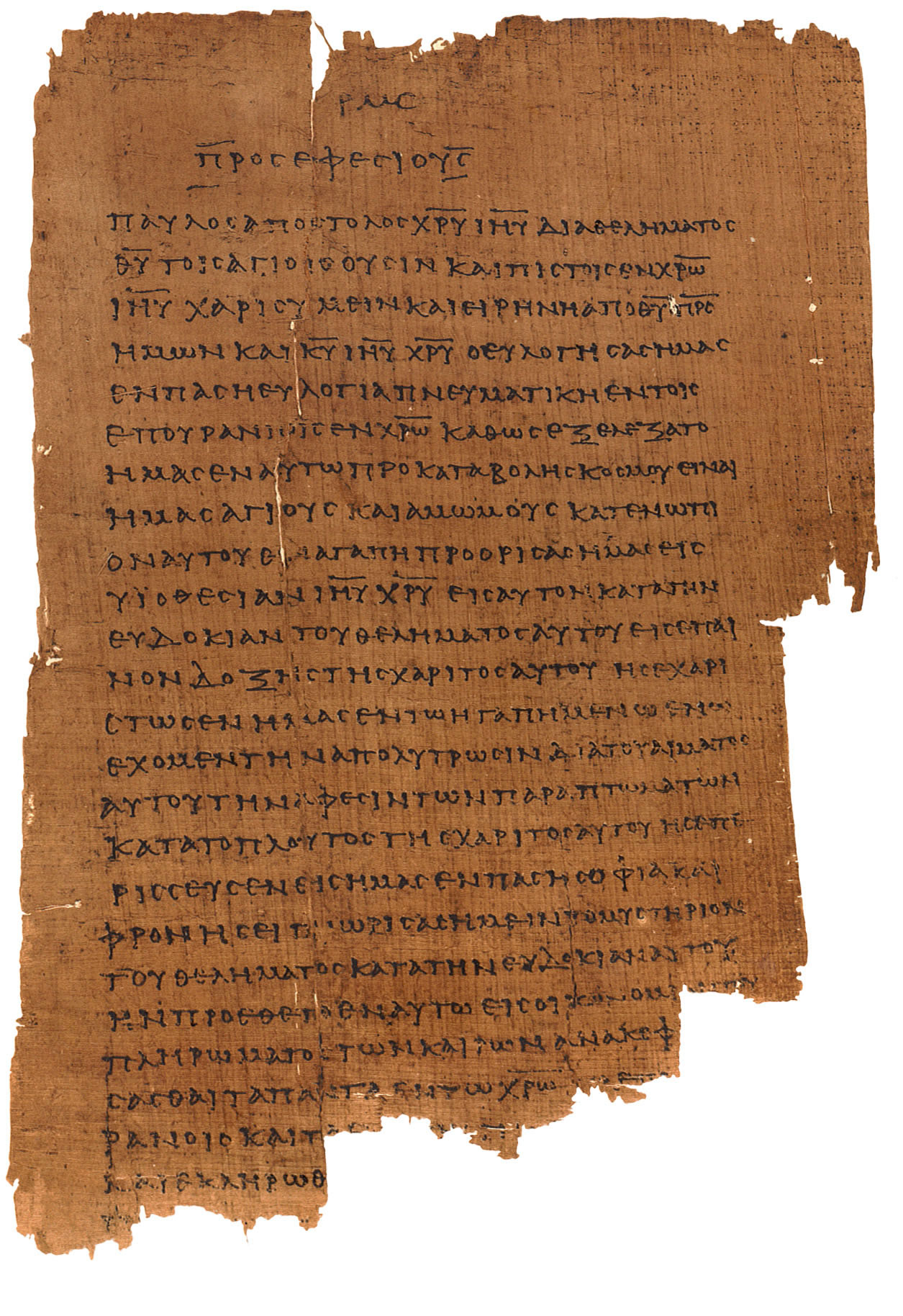
To provide an example of Houghton’s work, in his discussion of the variation ἐν Ἐφέσῳ “in Ephesus” in Ephesians 1:1, Houghton notes that the words are missing in some old and important manuscripts such as P46 (see above for Houghton’s comments).
To this point, some have suggested that the letter was a circular one. However, he points out that the manuscripts in which ἐν Ἐφέσῳ are missing still have the title of the letter as ΠΡΟΣ ΕΦΕΣΙΟΥΣ “To the Ephesians” and “the presence of οὖσιν (‘who are’) [in the text] suggests that a destination is likely to have been present, as the participle is otherwise superfluous” (465).
Finally, one of the things I appreciate the most about this volume and Houghton in particular is his academic humility, which is showcased in that he acknowledges that corrections and updates for this commentary will be needed. Therefore, he has set up a website where one can contact him with such corrections and updates as well as to make suggestions for future editions. For that website, click here.
In sum, this commentary, especially Houghton’s introduction, is clear, concise, and a wealth of information about the variation units in the forthcoming UBS6. I want to say thank you to Houghton for his labor on this work! This textual commentary is a necessary tool for study for any serious student of the New Testament. Therefore, I recommend you purchase it forthwith from Hendrickson or Amazon!
I am grateful to Hendrickson for this gratis advanced copy, which in no way influenced by review of it.