H. A. G. Houghton, A Textual Commentary on the Greek New Testament: A Companion to the Sixth Edition of the United Bible Societies’ Greek New Testament (Stuttgart: Deutsche Bibelgesellschaft, 2025)

The main goal of Houghton’s work is to provide a “new guide on current scholarship” related to the textual variations of the sixth edition of the United Bible Societies’ Greek New Testament (UBS6) to specialists and non-specialists alike. He accomplishes this goal by focusing on three things. First, Houghton describes the differing readings in the UBS6. Second, he weighs the evidence for each reading. And third, Houghton “explains why the form in the editorial text [the text that the UBS6 committee chose] has been chosen” (VII). To accommodate non-specialists, he provides an English translation of the editorial text and every Greek variant.
Houghton has divided his commentary into three main parts. In the first, he provides a preface (“Preface,” VII–VIII), where he states the abovementioned goal and processes by which he intends to achieve it, and lists of abbreviations (“Abbreviations,” IX–X), symbols (“Apparatus Symbols,” XI–XII), Greek manuscripts (“Principal Greek Manuscripts,” XIII–XVI) used and cited in the work.
The second part consists of an excellent, clear, and careful introduction (“Introduction,” 1–36) that discusses the diversity of New Testament textual witnesses, the reason for a scholarly edition of the Greek New Testament, the evidence for the text of the New Testament, the categories of New Testament textual witnesses, the principles of textual criticism, how the New Testament documents were produced, the grouping of manuscripts, the story of the UBS6 and Houghton’s commentary, and finally how to use the latter. Some highlights of this introduction are the balanced treatments of the reliability of the Greek New Testament, textual criticism and its limitations, textual families, and the story of the UBS6, Houghton’s commentary, and how to use it.
Concerning the former, Houghton acknowledges that provided the surviving manuscripts are representative of what was in antiquity, “there are no grounds for serious doubt as to the consistency of the New Testament tradition” (1). What is more, he concludes that contrary to the conclusions of some scholars there is “little evidence” that “scribes freely adjusted the text to match their preferences” and “theological presuppositions” (23). As it relates to textual criticism, Houghton notes in contrast to the confidence of some textual critics, textual criticism is an “art” of weighing probabilities (18). In his discussion of textual families, he observes that the grouping of texts by families such as the Western, Alexandrian, and Caesarean text types are outdated and should be abandoned because the only evidence for what one might call a textual family is the Byzantine text type (29).
The last highlight that I wish to underscore in this introduction is the story of the UBS6 and Houghton’s commentary and how to use the latter. The UBS6 is part of a “thorough revision” of the Greek New Testament in light of all available manuscripts, ancient translations of the New Testament, and patristic quotations of it in a project called Editio Critica Maior. To date, a team of international scholars has finished preparing the Greek texts of St. Mark’s Gospel, the Acts of the Apostles, the Catholic Epistles, and Revelation and the UBS6 adopts these revised texts. What is more, the UBS6 and Houghton’s Commentary (as well as the UBS6 Greek New Testament: A Reader’s Edition, for my review of it click here) have adopted the arrangement of the New Testament books in the complete Greek biblical manuscripts such as Codex Vaticanus and Codex Alexandrinus, which means that the Catholic Epistles (less Hebrews) follow Acts of the Apostles and Hebrews has been placed after 2 Thessalonians (31).


The UBS6 contains a total of 1,008 variation units and the committee has altered its confidence rating of these to the following:
“{A} The Committee is confident in this reconstruction of the text.
{B} The Committee is fairly confident in this reconstruction of the text.
{C} The Committee is doubtful about this reconstruction of the text.
{D} The Committee is extremely doubtful about this reconstruction of the text.
[Black titled square] A decision on the reconstruction of the text was left open” (32).
Houghton’s volume is a completely new work that comments on these 1,008 variation units as well as 224 entries that have square brackets in the UBS6 but no apparatus, offering “a more detailed explanation of all text-critical indications” (33). Houghton has structured his volume in the following manner. At the beginning of each book or collection of them, he provides an overview of that book or collection, focusing on the most important textual witnesses and variation units.

On the first line of the commentary on each variation unit, he lists the New Testament reference, the text in the variation unit, the NSRVue or his own translation for those who cannot read Koine Greek or read it well, and finally the committee’s confidence rating of the variation unit. Note that no confidence rating appears in the 224 instances where there are square brackets in the UBS6 text. Below this first line, Houghton provides the different readings in the UBS6 apparatus, their English translations, and then arguments for and against these variants with an eye “to how secondary readings might have arisen” (34). These entries, however, are not based on any committee discussions or opinions, but Houghton’s own in his attempt to present rationales for decisions made about the UBS6 text.

The third main part of this commentary consists of the actual comments on the variation units in the Greek New Testament (1–562, yes the numbers restart at 1), a glossary of terms used (563–68), and a bibliography (569–90).
To provide an example of Houghton’s work, in his discussion of the variation ἐν Ἐφέσῳ “in Ephesus” in Ephesians 1:1, Houghton notes that the words are missing in some old and important manuscripts such as P46 (see above for Houghton’s comments).

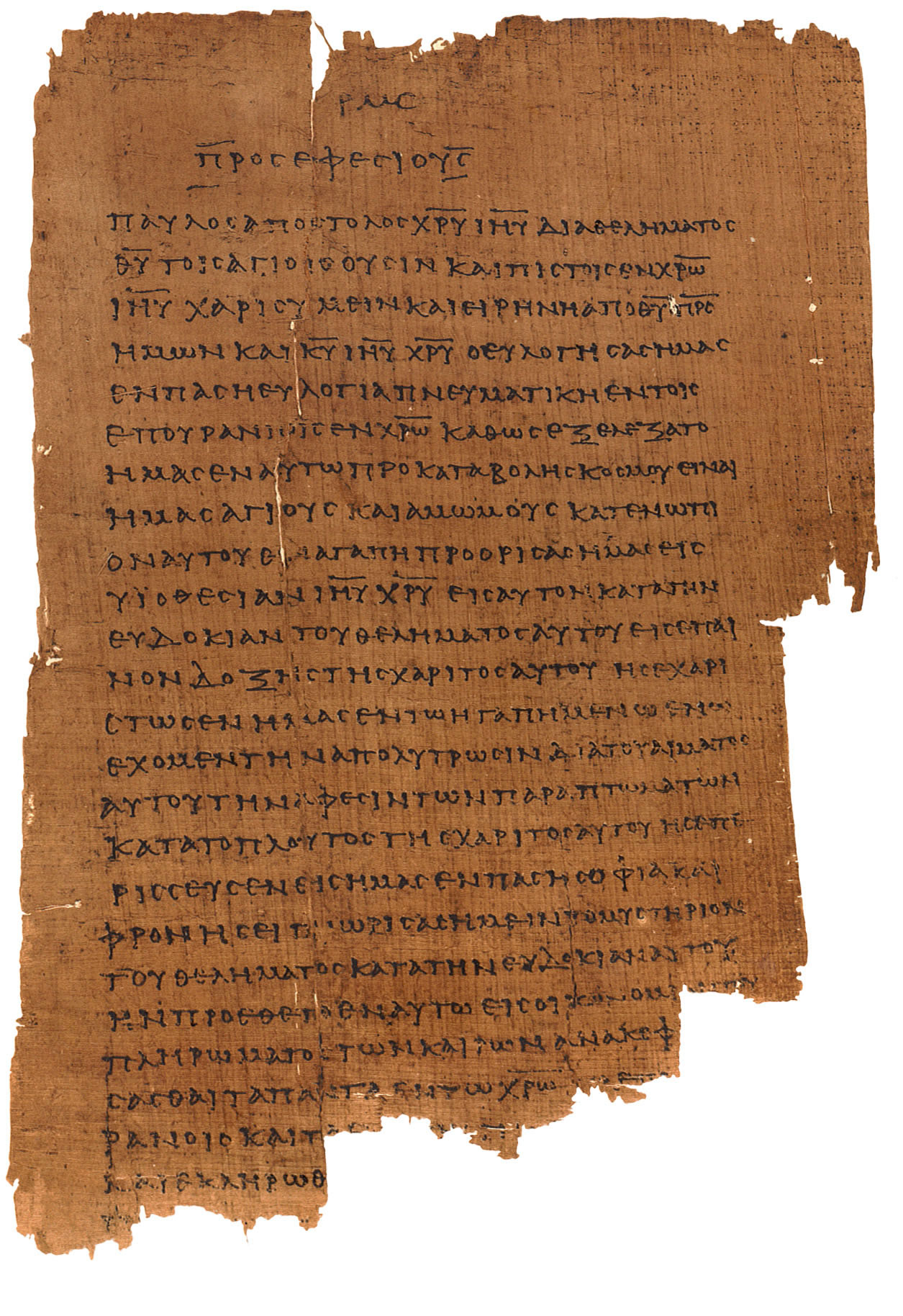
To this point, some have suggested that the letter was a circular one. However, he points out that the manuscripts in which ἐν Ἐφέσῳ are missing still have the title of the letter as ΠΡΟΣ ΕΦΕΣΙΟΥΣ “To the Ephesians” and “the presence of οὖσιν (‘who are’) [in the text] suggests that a destination is likely to have been present, as the participle is otherwise superfluous” (465).

Finally, one of the things I appreciate the most about this volume and Houghton in particular is his academic humility, which is showcased in that he acknowledges that corrections and updates for this commentary will be needed. Therefore, he has set up a website where one can contact him with such corrections and updates as well as to make suggestions for future editions. For that website, click here.
In sum, this commentary, especially Houghton’s introduction, is clear, concise, and a wealth of information about the variation units in the forthcoming UBS6. I want to say thank you to Houghton for his labor on this work! This textual commentary is a necessary tool for study for any serious student of the New Testament. Therefore, I recommend you purchase it forthwith from Hendrickson or Amazon!
I am grateful to Hendrickson for this gratis advanced copy, which in no way influenced by review of it.
For another, deeper dive into the Textual Commentary, see Chongs’s review: https://chongsworship.com