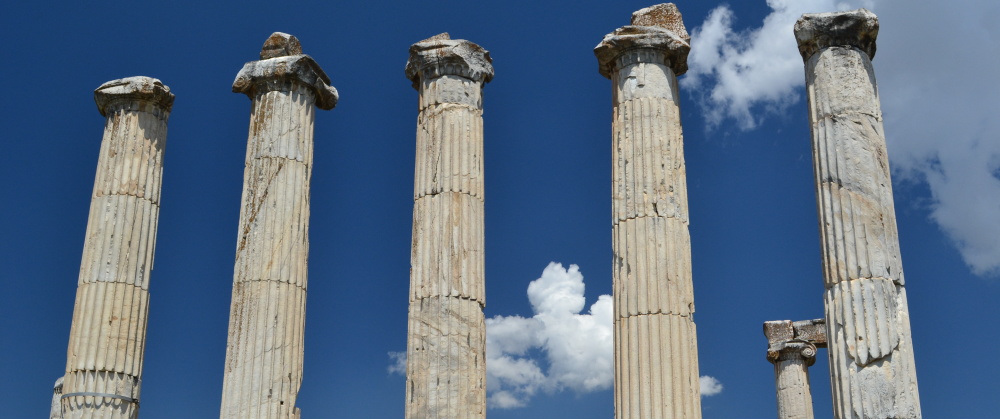
David A. deSilva, Archaeology and the Ministry of Paul: A Visual Guide (Grand Rapids: Baker Academic, 2025)
“The ruins of Rome are a constant reminder not only of Rome’s greatness but of the fact that no empire forged by human beings endures . . . The archaeological remains remind us—as Paul would remind his audiences—to look to the kingdom of our Lord and of his Christ if we are ever to fine a truly stable homeland” (281–82).

The goal of this volume is to introduce students of St. Paul to pertinent archaeological discoveries in the Greek and Roman cities associated with him for the purpose of better understanding the apostle’s letters through contextualizing the situations that preempted him to compose them and his responses to these situations in the epistles in question (xii). To accomplish this goal, deSilva divides his work into four parts: (1) a short introduction, (2) chapters devoted to cities connected to St. Paul’s early life and ministry, (3) chapters focusing on the cities in which the apostle established Christian congregations on his missionary journeys, and (4) chapters examining the cities he visited on his final trip to Jerusalem and journey to Rome.
In the “Introduction” (xi–xiv), deSilva lays out the above-mentioned goal, notes the temporal limitations of his work, for whom he has composed it, and summarizes the volume’s contents. Because deSilva desires to contextualize the letters of the Pauline corpus that were composed to congregations in which St. Paul planted churches, he mostly focuses on archaeological materials that the apostle would have seen and encountered, although sometimes he draws on materials that postdate St. Paul’s lifetime. To this end, the work is not a comprehensive introduction to the cities associated with the apostle, but only a snapshot of what they looked like in the mid-first century AD (xii).
DeSilva’s intended audience are those who have yet or who are unable to visit the sites covered in the book or those who can and wish to learn more about these cities and their relation to the apostle before their trip (xii). He divides Archaeology and the Ministry of Paul into three unequal parts related to St. Paul’s life and ministry that generally follows his chronology and movements from Acts of the Apostles.
The first part focuses on sites associated with the beginnings of the apostle’s life and ministry, which covers his early life in “Tarsus” (3–6), his time in “Damascus and Arabia” (7–14) and “Antioch-On-The-Orontes” (15–20), and his trip to “Paphos” (21–26) with St. Barnabas.
The second part, which is the longest, examines the cities in which St. Paul and his apostolic colleagues established congregations in various cities in modern-day Türkiye and Greece: “Perge and Pisidian Antioch” (29–50), “Roman Philippi” (51–77), “Thessalonica” (78–99), “Beroea” (100–7), “Athens” (108–25), “Roman Corinth” (126–56), “Roman Ephesus” (157–88), and “Colossae, Laodicea, and Hierapolis” (189–205).
In the third and final part, deSilva treats the cities connected to the last years of the apostle’s life as recorded in Acts, his final trip to Jerusalem, his imprisonment, and his journey to Rome: “Miletus” (209–18), “Rhodes” (219–24), “Jerusalem” (225–30), “Caesarea Maritima” (231–42), “Malta” (243–48), “Puteoli” (249–53), and “Rome” (254–82).
For the most part, deSilva begins each chapter by noting the connections of the city in question to St. Paul’s ministry. Then, he devotes the bulk of each chapter to discussing the archaeological and literary evidence of the site and how it illuminates the apostle’s letter(s) to the church in that city.
Archaeology and the Ministry of Paul is a welcomed addition to Pauline studies for three reasons. First, it is a thoroughly comprehensive treatment of the cities that St. Paul visited and missionized during his life and ministry bringing them together in a single volume. To this end, pastors and parish priests will find this work helpful as they prepare their homilies and Bible studies for their parishioners.
Second, deSilva mostly bases his work on up-to-date scholarship on the various sites from archaeologists and specialists who are working on them and students of the apostle can mine his bibliography to dig deeper, if they wish. This means that many incorrect assumptions that plague earlier studies about various archaeological data and St. Paul are not present in this volume. For example, deSilva has a balanced treatment of the Erastus Inscription from Corinth (147–48) (which is not the Erastus mentioned in Romans 16:23, if the latest archaeological findings are correct, see my podcast on the topic by clicking here) and of the Tiberius Inscription from Caesarea Maritima (242).
Third and finally, Archaeology and the Ministry of Paul fulfills its title as A Visual Guide, incorporating over 250 beautiful color pictures of the sites that St. Paul visited and their artifacts, which appear to be from deSilva’s own travels. To this end, not only does deSilva deserve praise but also Baker Academic for the layout of the book, the type of paper on which it was printed, and the high quality of its photographs: Bravo!
In sum, I highly recommend Archaeology and the Ministry of Paul: A Visual Guide and you can purchase your copy directly from Baker Academic or from Amazon!